① Connect
Connect your Strava account, we'll analyse your activities and calculate your risk of overuse injury.
myTF.run checks every run and tells you how much is too much, before overtraining becomes injury • All peer-reviewed sports science, no guessing.
Not on Strava? Join the waiting list and vote for your platform.
Fitness builds in weeks • Tendons and bones need months to catch up
“50% of runners experience an injury each year [...] 70%-80% of running disorders are due to overuse injuries”
Running too much too soon is one of the main causes of overuse injuries. Research links training load spikes to shin splints, runner's knee, stress fractures, plantar fasciitis, ITBS, and Achilles tendonitis.
myTrainingForecast estimates your risk of overuse injury and notifies you after every run, helping you spot when your training load may be increasing too quickly.
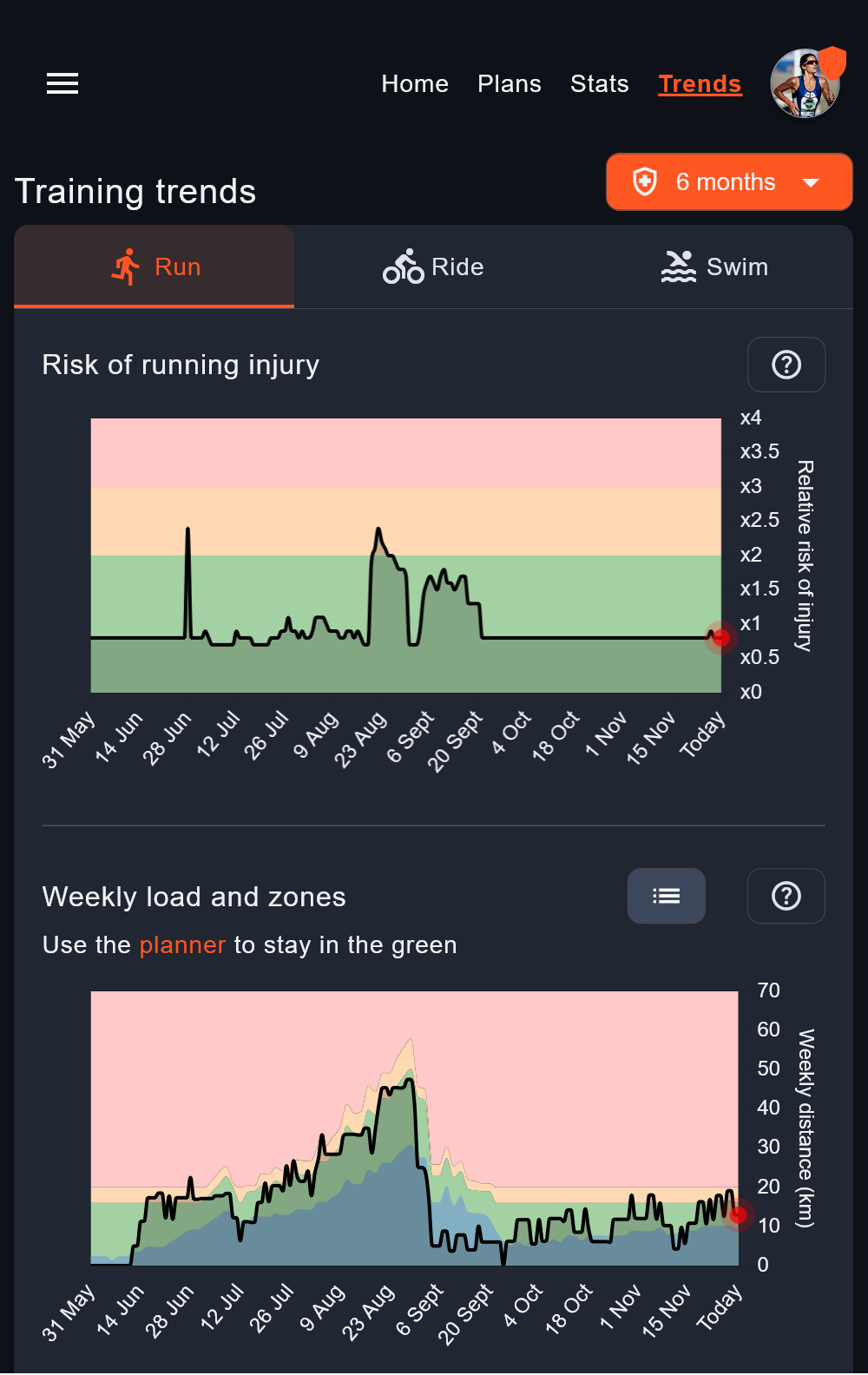
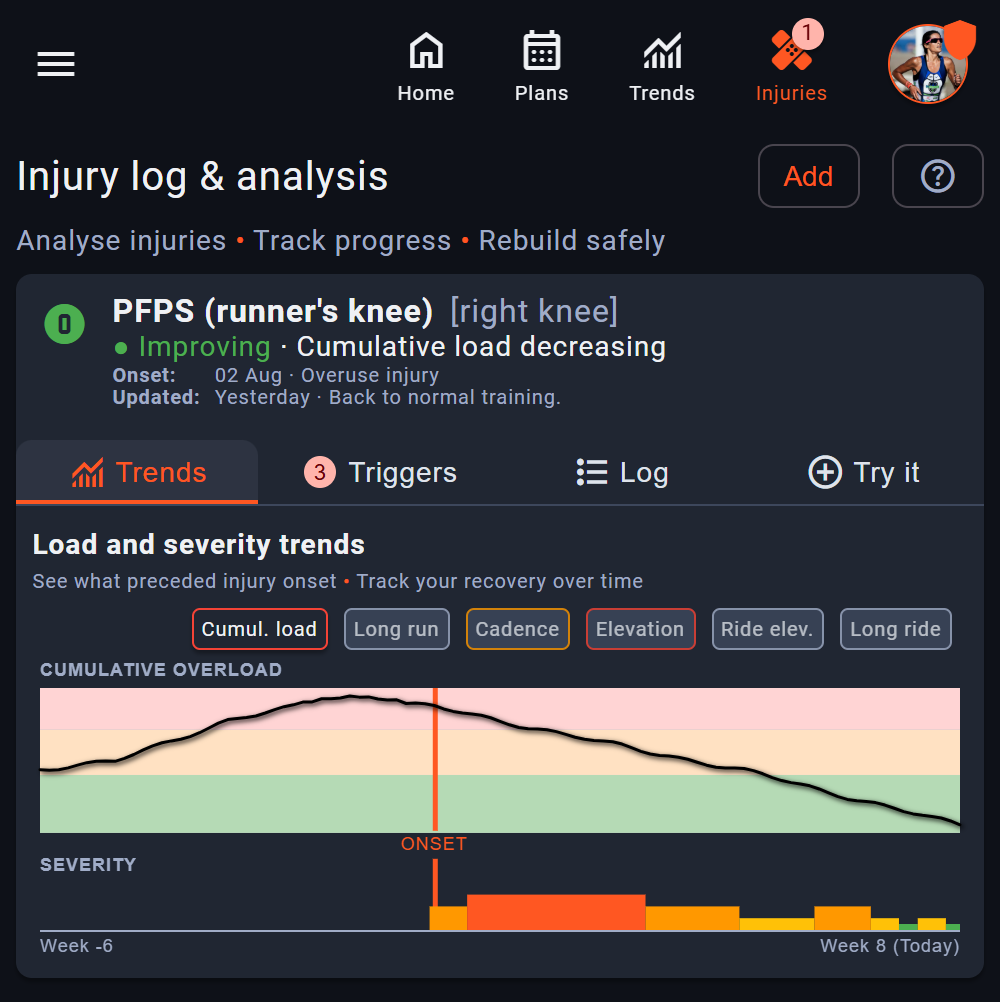
By the time an overuse injury hurts, the training error behind it may be two or three weeks in the past, and long forgotten.
Log a niggle or injury, new or old, and myTF lines it up against your training in the weeks before it started. It flags what was out of range for that type of injury, from load spikes to long runs, pace, cadence and elevation.
Then track how it feels as you recover, learn what to avoid next time, and give your physio the full picture.
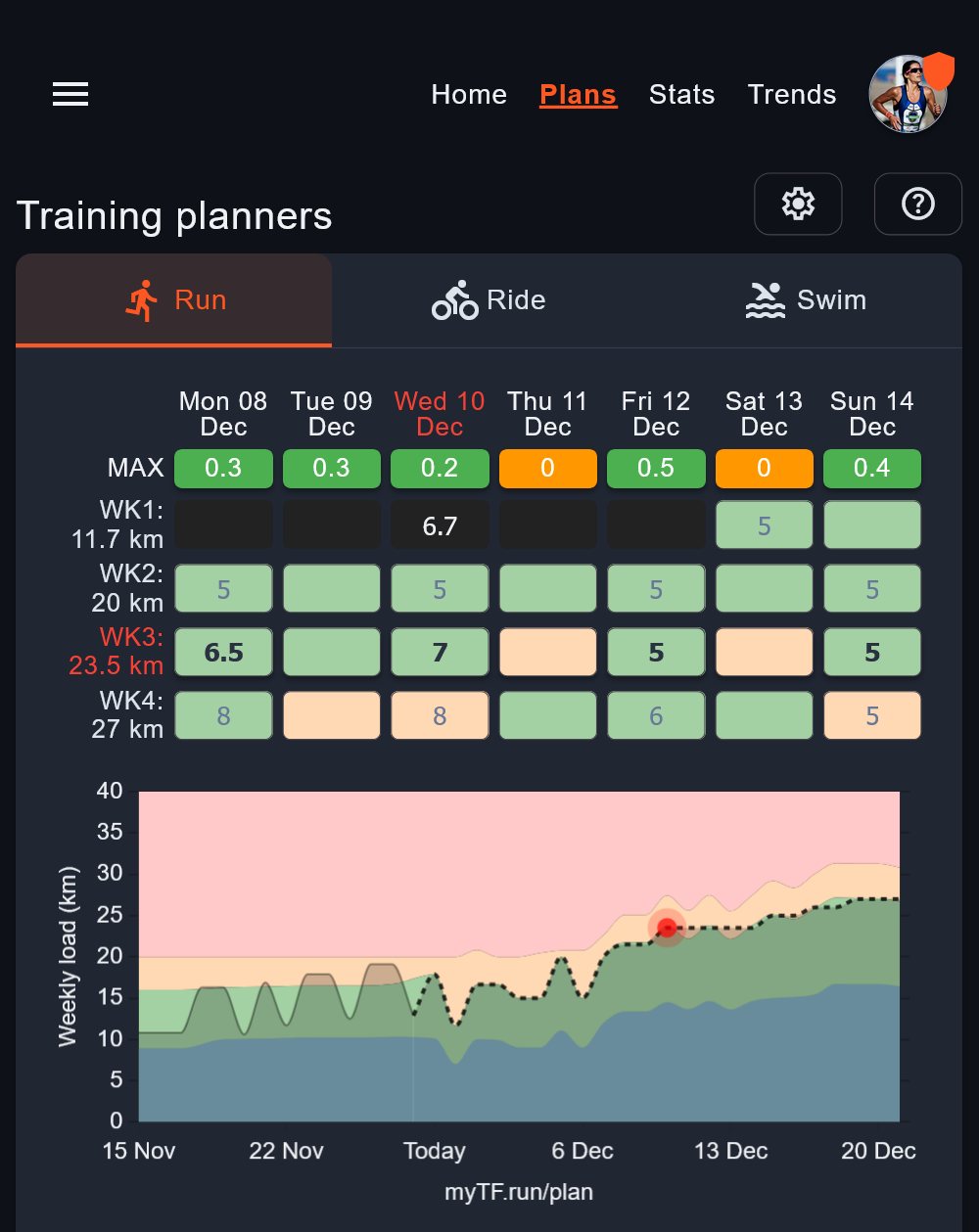
Use the planner to stay in the green zone and increase your mileage as safely as possible, no matter what life throws at you.
Whether you're a first time runner, building an aerobic base, or planning your return to running after injury, illness or a break, myTrainingForecast helps you avoid doing too much too soon.
Re-schedule your runs, and immediately see the impact on your future training load to avoid slipping into the red.
Connect your Strava account, we'll analyse your activities and calculate your risk of overuse injury.
Use the planner to schedule your runs, rides, and swims. Aim for the green zone to keep training safely.
After each run, we'll notify you if your risk of injury has changed.
“Since using this tool to manage my mileage and plan my runs I’ve remained injury-free while increasing weekly mileage from 12-15 miles to a current average of greater than 35 miles per week!”
“I’ve been using myTF.run for a couple of months now as I train for my first marathon."
"I’m now running more than I have ever before and although some niggles flair up, nothing like the stress fracture I suffered a year ago.”
“myTrainingForecast helped me plan a medium-term ultramarathon training plan, whilst also juggling training for other events. The 4 week outlook allowed for good planning but also great flexibility once the programme started, and I was able to push myself training-wise without any threat of overuse injury.”
“I still think myTF.run is one of the best practical training program development tools out there. I use it every week to check and adjust my personal training plan and I recommend it to other runners.”
myTF indicates your estimated risk of overuse injury (such as runner's knee, shin splints, stress fractures, or Achilles tendonitis), relative to an average runner. It does not cover trauma injuries caused by external factors (such as tripping or ankle sprains), which cannot be predicted from training data.
Our free model estimates risk based on your acute:chronic workload ratio (ACR), drawing on the methodology of Blanch & Gabbett (2015). It compares your recent training load (past 7 days) against your fitness level (past 28 days) to flag when you may be doing too much too soon. ACR is a widely used and intuitive monitoring approach, but it treats all runners the same regardless of background or training profile, and recent critiques (Impellizzeri et al., 2020) highlight that single-ratio metrics have limitations as standalone injury predictors.
myTF's Premium model uses a multivariable Cox proportional hazards regression to go beyond a single ACR value. It incorporates several training load dimensions, including weekly distance, longest run, and elevation gain, each with its own acute-to-chronic workload ratio, because the physiological stress from a hilly week is quite different from the stress of a single long run. These training metrics are combined with individual factors identified across meta-analyses and systematic reviews of running injury research, such as age, sex, running experience, injury history, and baseline mileage. The result is a risk estimate that reflects your training profile and personal characteristics, rather than a population average. This helps capture how different runners respond differently to the same training stimulus: a 50 km week that poses low risk for an experienced runner could represent a significant increase for someone recently graduating from Couch to 5K.
Both models are grounded in peer-reviewed literature, and the methodology is based on sports science consensus rather than black box AIs. No model can predict injury with certainty, and ours is no exception: training load is one important risk factor among several, and individual variation is significant.
Your acute:chronic workload ratio (ACR) is your 1-week load (total mileage for the past 7 days) divided by your 4-week average load (one quarter of total mileage for the past 28 days).
The acute (1-week) load represents your current training load. This is indicative of the stress your body is experiencing due to your short-term training. The chronic (4-week) load represents your current fitness level.
myTF uses 5 ACR zones:These ACR thresholds are guidelines drawn from research across multiple sports and populations (Blanch & Gabbett, 2015). They are useful for monitoring training load, but individual responses vary: Some athletes may venture into the orange or even red zone without getting hurt, while others might get injured whenever they exceed 120%.
myTF.run gives you the historic data and evidence you need to find what works for you, and which ACR zones you should train in.
Your aerobic system adapts to training in a matter of days. So you may feel that your fitness is improving quickly, and want to run more.
But connective tissues (muscles, tendons) and bones take much longer to adapt (weeks or even months). This is when running injuries can often occur: when we ramp up training faster than tissues can adapt.
Our ACR model can help you increase your training load more progressively, based on your actual progress rather than how you feel.
Cumulative overload risk is a myTF metric that estimates whether your tendons, ligaments, and bones have had enough time to structurally adapt to your recent training. It addresses a gap that most training-load tools leave open: connective tissues adapt and detrain on a much slower timescale than the aerobic system, and this difference is not captured by short-term load metrics.
Two things distinguish cumulative overload from the training-load metrics in common use:
Connective tissue, not aerobic readiness. Most established training-load tools (such as Banister's Fitness-Fatigue model, which underpins CTL/ATL in TrainingPeaks, Strava's Fitness & Freshness, and similar metrics) were designed to estimate when an athlete is fresh enough to perform. They track aerobic readiness, not tissue adaptation. Cumulative overload is built around the slower adaptation timeline of tendon, ligament, and bone.
A longer timescale. The standard acute-to-chronic workload ratio (ACR or ACWR) uses a 7-day acute load and 28-day chronic load, which is well-suited to spotting short-term spikes but cannot reflect structural adaptations that take months. Cumulative overload analyses training spikes on a ~3-month rolling timescale, closer to the times reported in tendon adaptation research (Kubo et al., 2010, 2012; Frizziero et al., 2011).
We are not aware of another consumer running app that explicitly models connective tissue adaptation on a multi-month timescale. If you find one, we would genuinely like to hear about it.
Your heart, lungs, and muscles adapt to training quickly: aerobic fitness can change meaningfully in days. Connective tissues operate on a much slower clock. Research suggests that meaningful increases in tendon stiffness and structural integrity require many weeks of consistent loading, and that tendons begin losing their adaptation within weeks of reduced activity (Kubo et al., 2010, 2012; Frizziero et al., 2011). This mismatch helps explain why runners are susceptible to tendinopathies: we feel aerobically fit and ready to run more, while our Achilles, hamstring, gluteal and patellar tendons have not yet caught up.
myTF's cumulative overload model analyses your training and estimates the progressive adaptation and detraining of connective tissues over time. It moves slowly by design: a single big week barely shifts it, but sustained progression that consistently outpaces tendon adaptation will push it up and keep it there.
For practical guidance on how to use this metric, see How do I protect my tendons and ligaments when running?
Around 50% of runners experience an injury each year, and the majority of running disorders are overuse injuries (Kakouris et al., 2021). Injury risk is multifactorial: training load, footwear, biomechanics, strength, sleep, and nutrition all play a role.
Two factors stand out in the evidence. First, training load: increasing mileage or intensity faster than the body can structurally adapt is one of the most consistently reported modifiable risk factors. Second, strength training: a meta-analysis by Lauersen et al. (2014) found that strength training reduced overuse injuries by approximately half across sports populations, although evidence specifically in endurance runners is more limited.
myTF focuses on the training load side of the equation, applying peer-reviewed models (including the acute-to-chronic workload ratio, ACR) and our own science-based models (e.g. cumulative overload) to your actual activity data. This gives you a continuous, data-driven view of where your load sits relative to your training history, rather than relying on generic guidelines like "don't increase more than 10% per week". It complements rather than replaces strength work and other prevention strategies.
Shin splints (medial tibial stress syndrome, or MTSS) are one of the most common running injuries, accounting for a substantial share of running and lower-limb overuse injuries (Deshmukh & Phansopkar, 2022).
MTSS involves repetitive microtrauma to the muscles and tissues that attach to the inner edge of the shinbone (tibia), particularly the tibialis posterior, soleus, and flexor digitorum longus, along with irritation of the periosteum, the outer layer of bone. This causes exercise-induced pain along the medial tibial border, usually in the middle to lower third of the shin. The pain typically starts as a dull ache during or after running and eases with rest, but if training continues without modification it can become persistent and may progress to a tibial stress fracture.
Rapid increases in training volume are consistently identified as a primary risk factor: the tibial bone and surrounding tissues need time to remodel under load, and increasing mileage faster than these structures can adapt is a common trigger. Other contributing factors include poor or worn footwear, muscular imbalances at the ankle, tight or weak calf muscles, higher body mass index, and running on hard surfaces (Bhusari & Deshmukh, 2023). Female runners and those with a history of previous shin splints are also at elevated risk.
Because training load spikes are one of the most consistently reported modifiable risk factors, monitoring your acute-to-chronic workload ratio (ACR or ACWR) is a practical, evidence-informed way to manage your risk alongside other measures such as calf strengthening, sensible footwear, and gradual surface progression. myTF continuously tracks how your weekly mileage compares to your recent training history, so when your load drifts beyond the zones associated with safer progression, you see it before shin pain sets in. This is especially relevant for new runners, runners returning from a break, or anyone ramping up mileage for a race.
Patellofemoral pain ("runner's knee") is the single most prevalent running and cycling overuse injury. A systematic review and meta-analysis by Smith et al. (2018) reported an annual prevalence of 22.7% in the general population, with particularly high rates in amateur runners and adolescent female athletes, making it by far the most common cause of knee pain in active adults.
Patellofemoral pain presents as diffuse pain around or behind the kneecap, typically worsened by running, squatting, using stairs, or prolonged sitting. It is widely accepted to be multifactorial: contributing factors include hip and quadriceps strength, lower-limb biomechanics, foot mechanics, and load-related tissue stress. Among modifiable factors, training errors (sharp week-on-week increases in volume or intensity that outpace tissue adaptation) are commonly implicated, alongside strength deficits at the hip and knee.
myTF addresses one piece of the puzzle: load progression. It monitors your training across multiple dimensions (distance, longest run, and elevation gain) and flags when your progression exceeds the thresholds that published research associates with elevated injury risk. Because runner's knee tends to develop from cumulative overload rather than a single session, the multi-week view in the planner is particularly useful for spotting gradual drift into higher-risk zones before knee symptoms develop. For best results, combine this with hip and quadriceps strengthening as recommended by current physiotherapy guidance.
Overtraining occurs when cumulative training stress consistently outpaces the body's capacity to recover. The result can be a downward spiral: persistent fatigue, declining performance, disrupted sleep, and an increased risk of injury.
The acute-to-chronic workload ratio (ACR or ACWR), as described by Blanch & Gabbett (2015), provides one objective way to track this balance. An ACR sustained in the 80–130% range has been associated with lower reported injury risk in several studies; sustained spikes above 150% have been associated with elevated risk.
By calculating your ACR daily and plotting it over time, myTF gives you an early signal that complements how you feel. This is particularly relevant for runners who feel fine during a ramp-up: aerobic fitness adapts in days, but tendons and bone remodel over weeks to months, and overload there often goes unnoticed until damage is already done.
Tendon and ligament injuries (Achilles tendinopathy, patellar tendinopathy, plantar fasciitis, tibial stress fractures) account for a disproportionate share of overuse running injuries and are notoriously slow to heal. Connective tissue has limited blood supply and a slower repair capacity than muscle, which means a tendon injury can sideline a runner for months rather than weeks.
Tendons and ligaments are less richly innervated than muscle, so structural overload often goes unnoticed until damage is accumulating. You can be training hard and feeling good aerobically while your connective tissue is being stressed beyond its current adaptive capacity. By the time pain appears, the structural deficit has often been building for weeks.
myTF's 'Cumulative overload' chart estimates whether your connective tissues have had enough time to structurally adapt to your training. It moves slowly and reflects the gradual drift that can lead to tendon injury before symptoms develop. Many running apps focus on short-term load spikes; myTF's unique cumulative overload model looks at whether your tendons are keeping up with your training over the longer arc of a season.
It is particularly useful in three situations: during a progressive training build towards a goal race, when returning after a break or injury, and after a period of reduced training when fitness has recovered faster than structural readiness. In all three, the aerobic feeling of being “ready” can outpace actual connective tissue adaptation.
Aim to keep your cumulative overload in the green zone during sustained training blocks. Passing through the orange zone during a deliberate build is normal, but treat persistent time in that zone as a signal to slow the rate of progression. The red zone warrants a planned easy week, not necessarily rest, but enough of a reduction to let adaptation catch up.
For a full explanation of how the metric is calculated and what the zones mean, see What is the 'Cumulative overload risk' chart?
The return-to-running phase carries some of the highest re-injury risk. After time off, your chronic load drops, meaning even a modest run can spike your ACR into the red zone. The evidence supports a graduated, load-monitored return rather than jumping back to pre-injury volume (Taberner et al., 2019).
myTF's planner lets you map out a week-by-week return and instantly see how each session affects your projected ACR. This makes it straightforward to build back progressively while staying within zones associated with lower injury risk in the published literature. We recommend coordinating return-to-running plans with a physiotherapist or qualified clinician where appropriate.
myTF is a training load monitoring and injury risk tool for runners, with support for cycling and swimming. It connects to Strava and applies published sports science models, including the acute-to-chronic workload ratio (ACR or ACWR), multivariable risk factors, and population-level injury data, to your actual training history.
The goal is to give you an objective, data-informed view of your injury risk that goes beyond generic rules of thumb such as the "10% rule". Thousands of runners use it to manage training load, plan safe mileage progression, and reduce avoidable injury risk. myTF is not a substitute for clinical advice, strength training, or other prevention strategies.
myTrainingForecast is built by runners, for runners. No ads, no data selling, and no investors calling the shots.
We offer a Premium membership with advanced injury prediction, personalised model, multi-sport tracking (runs, rides, swims), extended planning features, and more. Your Premium subscription helps keep myTF independent and ad-free while supporting ongoing development.
Yearly subscription costs less than a session of physio!